 Docs
DocsRun the production workflow
Move a Shopify order through artwork review, scheduling, printing, quality control, packing, and shipment with one audited job record.
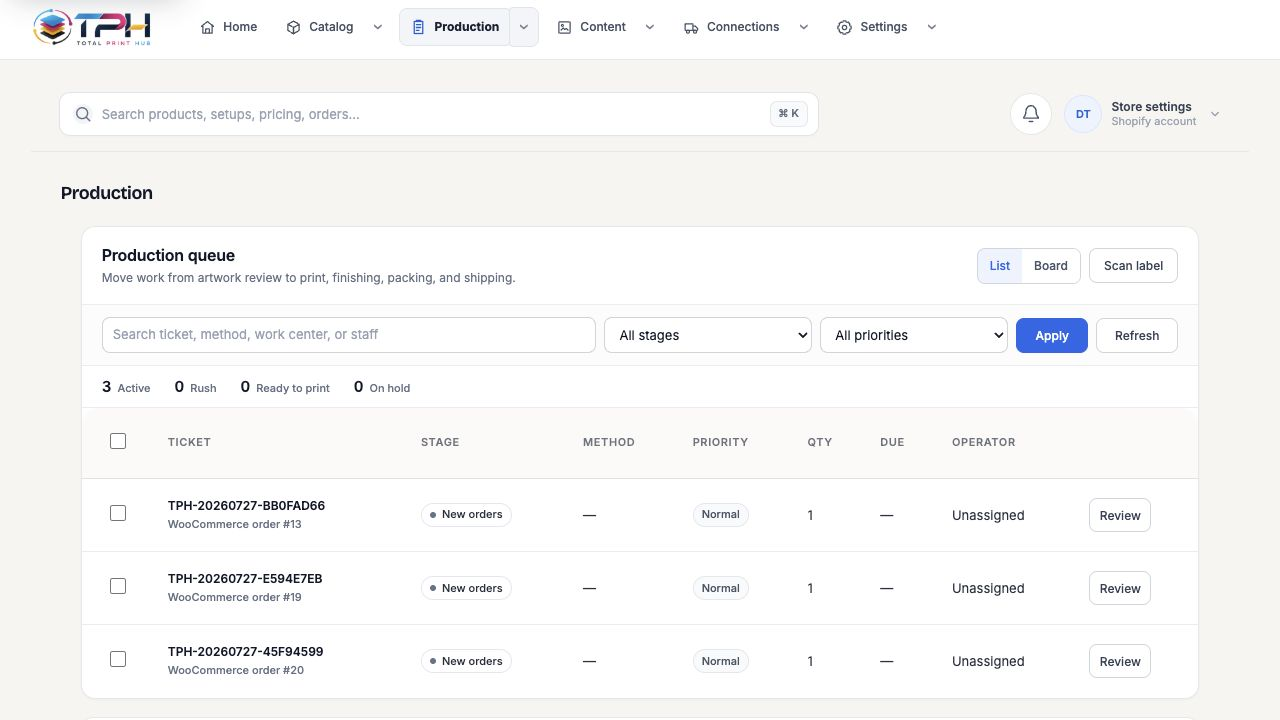
How a job enters the queue
A verified Shopify order line with a Total Print Hub design reference creates one original tenant-scoped production job. Webhook retries reuse that job instead of creating duplicates. Manual work can be created by an authorized merchant when it does not originate from Shopify.
- Ticket and Shopify order/line context
- Product, variant, SKU, quantity, method, design, and production package
- Priority, due date, assignee, work center, notes, and current stage
Configure the floor once
- 2.1
Open Production → Workflow and review the prepared stages and allowed transitions.
- 2.2
Keep only the stages the shop uses and make every allowed next step explicit.
- 2.3
Create work centers with stable code, time zone, supported methods, and daily capacity.
- 2.4
Attach printers to the correct work center and record method support, operating state, capacity, and connection mode without storing endpoints or credentials in the browser.
- 2.5
Use the seven-day schedule to find overdue, unassigned, full, and overbooked work before promising a due date.
Prepare artwork, proof, and materials
- 3.1
Open the job and review the linked design, source assets, fonts, preflight, proof state, and owner package.
- 3.2
Record artwork approval or requested changes without replacing the original history.
- 3.3
Review calculated material requirements and shortages.
- 3.4
Reserve available stock for the approved job.
- 3.5
Consume the reservation once at the guarded production handoff; retrying the same action must not deduct it twice.
Use labels and scans safely
Issue or rotate a job label only when a physical barcode or QR label is needed. The raw scan code is returned once; only its hash is retained. Rotating the label immediately invalidates the previous printout.
- 4.1
Print the newly issued job label.
- 4.2
Scan it at the intended work center.
- 4.3
Review the resolved job, current stage, and allowed next action.
- 4.4
Confirm the one-scan print handoff; a scan never bypasses a forbidden transition or required approval.
- 4.5
Reissue the label if it is lost rather than copying a raw token into notes or chat.
Finish with traceable exceptions
- Record QC pass, failure, hold, and exception details
- Create a reprint or remake as a linked descendant instead of erasing the original job
- Record packing readiness, carrier, service, tracking, and shipment events
- Use queue, due-date, material, throughput, exception, and audit views for daily decisions
Safe operating rules
- Use bulk assignment only for selected eligible jobs; stale rows stay unresolved for refresh instead of overwriting another operator
- Keep supplier submission separate from the internal print handoff unless the authorized adapter is configured and proven
- Do not mark a job ready to print while required artwork, proof, product mapping, material, or export checks remain blocked
- Never place raw scan codes, supplier credentials, signed download URLs, or customer files in general notes